Last year, I wrote in depth about Varner Studio's display at SDCC. Over the last couple of decades, the company has been responsible for sculpting many toys and is now at the forefront of digital sculpting. At this year's show, they once again had an excellent display. Here's a look at what they brought.
In their display cabinets, Varner had a mix of figures sculpted by hand and digitally, as well as figures at the final stage of development and production.
One of the pluses about SDCC is it lasts 4.5 days (including preview night), allowing attendees to take in quite a lot of the show. After checking out the big booths, attending panels, buying toys, and lining up for all of the above, you can still build in slack time for wandering the aisles. And this is where some of the best SDCC experiences can be had, especially if you take off your toy or art or comic or whatever "focus blinders" and take a chance to soak in something new.
One of my unexpected pleasures of SDCC 2014 was the Varner Studios booth, where I learned a lot about new trends in action figure sculpting. I even had a chance to try my hand at cutting edge toy design software.
The booth was populated by a knowledgeable and friendly crew who brought along an excellent assortment of their design work.
Most of the figures in the two cases were crafted the old-fashioned way - by hand. Varner clearly has a great relationship with Playmates, as the shelves were chock full of Teenage Mutant Ninja Turtles prototypes from yesteryear and today.
Also on hand were figures based on other properties including Disney characters, Star Trek, Austin Powers, The Simpsons, and so on. We'll continue after the jump with a gallery scroll through a number of these figures:
GI Joe is probably the most iconic toy of the last 50 years.
And it has stood the test of time, morphing from a heroic grunt in the 60s to a
brass adventurer in the 70s to a cartoon driven 4” action figure in the 80s.
To most of us, the original 12” figure is, well, just a
legend – something we’ve seen in photos or maybe at a toy show, but don’t know
too much about. And yet every great toy has a great story behind it – the why’s
and how’s of its development, the people behind it, and the design and
production process.
That’s where books like GI Joe: The Story Behind the Legend
come in. This is not a new book – it was published by Chronicle Books back in 1996. But that doesn’t
matter. The original events all took place in the early 1960s, so this account
doesn’t feel dated, even nearly 20 years after publication. I have to say, the
book is flat out fascinating. If you’re a GI Joe fan or are interested in toy
history, action figures, toy development, or just plain amazing stories about a
year-long team effort to make something great, then you might want to check it
out.
One of the things I love looking out for at shows is in-development sculpts and other prototypes of upcoming figures. Sometimes they're tucked away on a back shelf, and sometimes makers place them front and center to give everyone a closer look.
I had a chance to see several upcoming figures. First,
there's Rotogirl by longtime toy maker Pete Fowler, who is really one of
the pioneers in the scene.
The proto sculpt, on display at the Clutter booth, features some
trademarks of Pete's toys. It has a statuette feeling, so it doesn't
look like it will have much articulation, but it's still an attractive,
dynamic sculpt and should go nicely in a collection of Mr. Monsterism's toys.
Tokyo isn't the only place in Japan with sofubi factories. As I recently discovered, toys are also being made in the heart of downtown Osaka, in a toy factory run by Jungle. It's in the Nipponbashi district, which is home to many toy shops, maid cafes, and more vending machines than you can throw a stick at. Which you should never do, because vending machines are lovely, and sensitive.
Jungle has a very big toy shop nearby, and they put on toy shows once in a while.
This is a working factory, but they let me shoot a short video, which was cool. Here it is:
If you want to get in touch with them, there's contact info here. In the past, they've had folks working there who speak English, so it may be easy to communicate with them via e-mail.
I stopped by Super7's booth to talk with their owner, Brian Flynn, about the new Alien ReAction figures. Brian talks about how this dream-come-come project came together.
Here's a video I shot at the Shikaruna studio. In this video, traditional paint masks are being used to spray the Shikaruna Oni figure. I was astonished to learn that there are around FORTY masks for this one figure. That's a huge up front cost, as paint masks are meticulously hand-made by master craftsmen using high quality materials. It can cost $150-$200 or more for a single mask.
After watching some painting from different angles, I look inside the studio/shop to look at some of the figures on display, for sale, and in various stages of development.
The video is in HD, so make sure to expand it to full-screen to see all the details.
Yesterday I visited the Fort to catch up with Luke and Ricky. The Fort Boys are always working on toys at some stage of the development process, since they're doing pre-production-> production work for more and more designers, not to mention for their own lines: Grody Shogun + Velocitron.
An important part of the process is making wax casts from silicon molds. Those casts then go through a labor-intensive process as they're prepped for the joint + mold stages. However, not all casts are ready for prime time, and that wax, instead of being thrown away, is melted down, strained, and reused.
During my visit yesterday, Luke put a bunch of wax pieces into a metal bin, brought out a burner, and started cooking. After a few minutes, it had a cool melting effect as the pot bubbled and the various parts were reduced to a formless liquid. Here's a video I shot to capture the action:
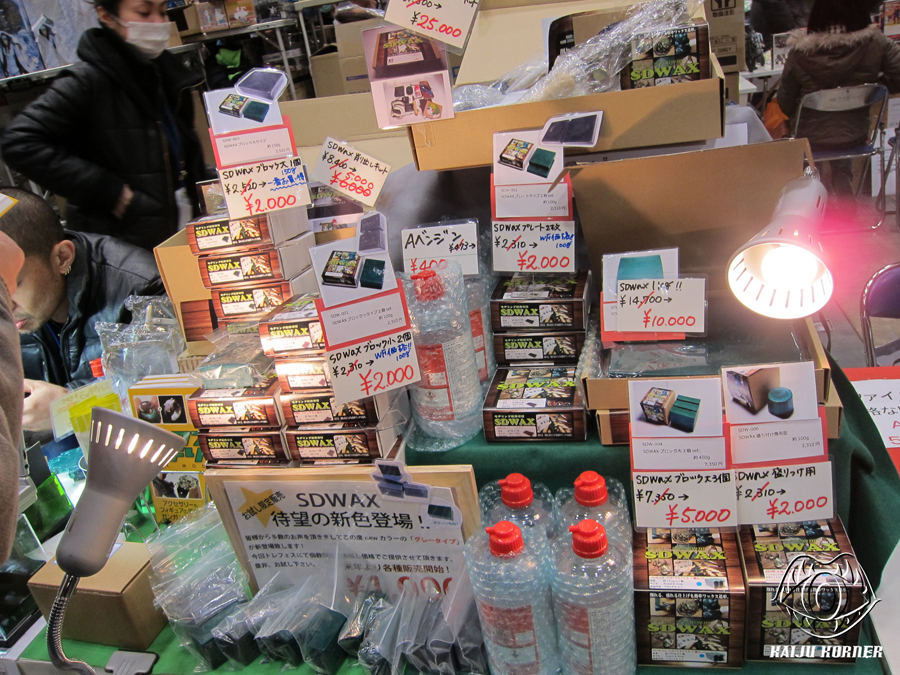
Solid Design was one of the more interesting booths at the recent Wonder Festival. I wanted to write them up separately to highlight what they're doing. Typically in the toy making process, you sculpt a figure, and a wax proto is made from that sculpt. The wax is then used to make the copper molds which are ultimately used to pull the vinyl.
Well, Solid Design is selling wax (which one would assume has some special properties + composition) that you can directly sculpt from. That cuts a step out of the toy making process. You can go directly from the sculpting stage to the mold making stage.
I'm not sure which method or sculpting material works the best (this or the traditional sculpt --> wax--> mold process), but I figure the more knowledge that's out there the better.
Here are examples of figures made from the wax:
And here's the owner (?) working on a sculpt:
Chunks of wax can be sawed off, refined, and added to the sculpt.
More tools and accessories at the booth:
Finally, a video of a new sculpt in progress:
They have a pretty extensive website (all in Japanese though) where their products are introduced and sold.
Most sofubi is done free spray, but a lot of makers also have masks made to spray certain areas of their figures. Masks allow for very precise paint work as well as complex designs. The downside is they're very expensive, costing hundreds of dollars for even very small masks.
Here are a few masks used by Luke Rook (Grody Shogun Lulubell).
Rampage Toys has plans to give Ugly Unicorn the endoskeleton treatment. When I met up with Jon at Design Festa 34 the other day, he had clear parts on hand, as well as a prototype skeleton to test the concept.
First off, here's a snap I took a couple weeks back of a bag of clear Ugly Unicorn top and bottom halves.
One of the figures assembled.
Skeleton sheet that Jon made.
And the figure with the internal parts.
I think it's cool the way Jon is experimenting with so many techniques. Looking forward to seeing how this version turns out.
PS: Jon wrote in to add he made 5 proto skeleton versions, and they've all been sold and shipped to the U.U. faithful. The next batch of endo-uglies is slotted to be sold at the next Superfestival.
One of the funnest things about Grody Shogun's Monster line is the multiple body parts. That includes 4 bodies, 6 arms (3 left + 3 right) + 6 heads. As I've reported before, the figures are all based on two monsters: vampires and Frankenstein. In fact, all six heads were made from just two sculpts. Luke made several wax protos of each head, and from those, he sculpted the variants. So in addition to smooth heads, you've got others that are angular, coarse, etc.
Luke keeps the sculpts around in case he wants to create more mayhem down the line. The above pic shows the two original Monster head sculpts. Bit of Grody Shogun lore.
Here are a couple more behind the scenes in development shots of Tara McPherson's upcoming sofubi figure: George the Vampire. The figure, which was previously made in resin, is being produced by Cherry Vinyl, a joint toy-ad-venture between Lulubell and Pretty in Plastic.
Both halves of the head mold
These are silicon molds for the head and heart pieces. Wax is poured into them, and when it hardens, the wax proto is used to make the final copper molds.
Both head mold pieces + 1 of the heart molds
Here's a shot of the original sculpt from which the above mold was made:
Click here to see more shots of the prototype sculpt.
As part of the sofubi toy development process, silicon molds are created using the original sculpted parts. This is done one body part at a time, so if a toy has four points of articulation (for example, at the head, left arm, right arm, and waist), it will have five body parts, each of which goes through the same steps on its way from sculpt to sofubi.
After a silicon mold is made, it's used to create a wax proto.That is the final piece of the puzzle, used to make the copper molds which are then used to make sofubi parts.
Ricky Wilson (Velocitron), shown in the above video, has been creating sofubi toys for years. In fact, he's one of the first to help overseas indy designers get characters like Kusugon and Ollie made into sofubi toys. In the video, which I shot the other day at the Fort (where Luke Rook (Lulubell/Grody Shogun) also plies his craft) Ricky is pouring silicon into state of the art mold frames. (I've been told others use Legos and other materials/barriers to hold the silicon in.) You can see little bumps sticking up in each of the frames. Those are the sculpted parts, which are slowly being covered with silicon.
Cherry Vinyl (a joint project between Lulubell and Pretty in Plastic) is starting to fire on all cylinders. This week at NYCC, they're releasing a new version of Femke's Le Chat sofubi figure as well as resin versions of Nathan Jurevicius's Akis and Tara McPherson's George the Vampire. (Click here for pics of all that.)
Tara's fans will be happy to know that George (which was sculpted by Julie B of Pretty in Plastic) is set to get the sofubi treatment. The prep work is being handled by Luke the Grodmeister in his Koenji Fort.
Here are pics of the final sculpt, used to make the copper molds from which the sofubi figures will be pulled.
I really like the sculpt on this figure. Great job Julie!
Very bold figure design with the leg lean.
Slot for a removable sofubi heart. So cool!
Really nice detail on the hands too, and again a bold design as they're in a cupped, "claws out" posture.


.JPG)
.JPG)
.JPG)


.JPG)
.JPG)