Showing posts with label tokusatsu. Show all posts

Saturday, January 24, 2015

Vintage Discoveries #2: Condorman book + flexi disc


Condorman book + flexi disc set
In the late 1960s-early 1970s, records for children's movies, TV shows, and anime started to become popular in Japan. The good thing about vinyl records (like the one in my first Vintage Discoveries article) was they were well made. The bad news is they were expensive.

Enter flexi discs, the thin, clear plastic records that might be green, blue, or red. These were so cheap that you could pair them with a mini book and still sell them for less than the cost of a vinyl EP. In the late 60s, flexi discs were really thin and floppy, and they were easily damaged. These were known as "sonosheets." Asahi was one of the main companies in the field, and their Asahi Sonorama (朝日 ソノラマ) series included book + sonosheet sets for titles like Ultraman, Mighty Atom (Astro Boy), etc.
Asahi Sonorama Mighty Atom mini book + sonosheet set

sonosheet
Advances in music printing technology came quickly, and in the 1970s, a new series of Asahi book + recording sets was launched: the Sonorama Ace series. The full title is Sonorama Ace Puppy Series (ソノラマエースパピイシリーズ). Note the puppy in the top right corner of the very top pic.

In this series, the paper was thicker for the mini books, though the internal binding wasn't the best, leading to pages easily becoming separated.
Mini books were typically around 6-8 pages long. In this Condorman book, the lyrics to one of the flexi disc's songs are on the right-hand page, and a mini story (not recorded on the disc) starts on the left.
The new flexi discs in the Sonorama Ace series were thicker and sturdier than the discs from the 60s. Called "punch sheets," they were made from a clear red material.
Condorman "punch sheet" containing one song on each side.
It's worth noting that few people will know what a "punch sheet" is, so in Japan the general term used is "sonosheet" for all types of flexis.

More after the jump:

Sunday, September 21, 2014

Extremely rare vintage 12" Takara figures

Here's some real vintage lore. I wanted to put these up for general reference, as I've never even seen one of these boxed, and here is a large group. These are 12" tokusatsu figures by Takara, made in the early 70s.

Most of them are priced at $3,000-$4,000 each but are all unsold, so who knows if that's a realistic price. I guess when there are so few of them out there, whoever has them can make up the price.

With apologies in advance for the image quality. It was dark and raining.
Ultraman Ace. This is priced at a cool 1 million yen ($10,000).


 More after the jump:

Thursday, January 17, 2013

Super Festival 61 (スーパーフェスティバル61) Part 3: Mighty Jack Exhibition

Our final report from Super Festival 61 is a look at a special exhibition of Mighty Jack (マイティジャック) items. Mighty Jack was a TV show from the late 1960s, making it one of the earlier tokusatsu shows - buoyed perhaps by the Ultraman wave.

These types of exhibitions are regular at each SF, with toys, games, props, paperwork, and other related items. It's a nice inside look at what is usually a very fine collection of items.

Plastic masks like the one in the top left were made for a ton of different shows. One sometimes sees them displayed on the ceilings of toy shops.

More after the jump:

Friday, December 28, 2012

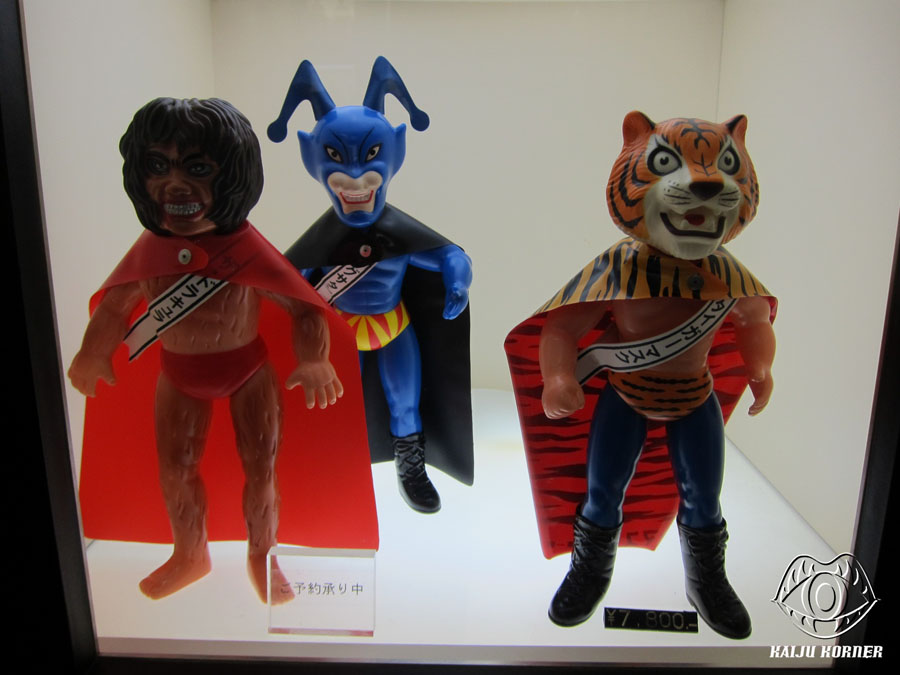
Medicom Tiger Mask figures

Spotted at the Medicom Project 1/6 shop in Shibuya. Closeups:

 More after the jump:

Saturday, December 22, 2012

Ultraman Ace vs. Henshin Ninja Arashi: A tokusatsu tale

Tokusatsu refers to live action movies or TV shows with costumed heroes and villains. It's a venerable form of entertainment in Japan, going back more than half a century to cinematic trailblazers like Toho's Godzilla (1954) and small screen giants like Tsuburaya's Ultra Q (1966) and then, immediately, Ultraman that same year.
Godzilla, 1954

Ultra Q, 1966
In the 1970s, there was an explosion in new tokusatsu shows. The decade got off to an impressive start with Toei's Kamen Rider (1971), which was created by legendary artist Shotaro Ishinomori. In fact, many of the decade's most famous shows were created by Ishinomori, whose family name at the time was Ishimori - but that's another story.
Kamen Rider, 1971
Following Kamen Rider were other Ishinomori creations like Kikaider, Inazuman, and Gorenger. Then there was Henshin Ninja Arashi, which brings us to this story.
Henshin Ninja Arashi, 1972

Arashi, a Toei release, follows a similar pattern of other "henshin" tokusatsu of the period. You've got your hero (Hayate), a pair of children, an arch nemesis (in this case, Majinsai), legions of incompetent henchmen (who tend to do somersaults as they go down), and a weekly main villain (sent forth by Majinsai) with a bloodlust for taking down our hero.

When trouble calls, Hayate strikes a pose and becomes Henshin Ninja Arashi, a karate expert with a mean sword and a blazing purple scarf. By the end of the show, Arashi saves the day, sometimes with the help of his trusty steed.

Henshin Ninja Arashi debuted on April 7, 1972. Its timeslot was 7:00-7:30 on Friday evening, a great way for kids to wrap up the school week and get ready for the weekend. So far, so good. Well, maybe not.

Unfortunately for Arashi, Tsuburaya released its newest Ultraman series - Ultraman Ace - that year. You may be thinking that's OK - a little competition can be a good thing, right? It gets worse. Ultraman Ace debuted....yep, you guessed it, on April 7, 1972 - the exact same date as Arashi.
Ultraman Ace
Well, that's OK, right? Kids could watch two shows on one day - awesome! Nope, not so awesome. The Ultra juggernaut slotted in at the EXACT same time as Henshin Ninja Arashi - Friday night from 7:00-7:30, on another channel.

So if you were a kid in the early 1970s, before VHS, DVD, or other recordable media, you had to choose between one show or the other. The person I heard this story from told me that he wanted to watch Arashi, but he ultimately chose Ultraman Ace. And so did the majority of a generation of kids, no doubt. Score a victory for Tsuburaya.

And so things go in the competitive world of children's entertainment. Arashi lasted 47 episodes, which wasn't too bad, but the show became something of a footnote in the legacy of tokusatsu shows. Ultraman Ace went on to broadcast 52 episodes, and the Ultraman franchise continues on in various forms and media to this day.

Toei wasn't down and out by any measure. Its flagship series Kamen Rider carried on strong in various incarnations, through new series and movies, and it never left the popular imagination even when there were no programs airing. It remains an iconic series and there are no doubt epic discussions on forums in many languages about which is better: Ultraman or Kamen Rider. Now that would make a fine Epic Rap Battle of History!
Related Posts Plugin for WordPress, Blogger...