As the story goes, sofubi manufacturing came to Japan after World War II, as one of the industries set up to help the country on the path of economic recovery. In addition to making toys for home grown properties like Godzilla, Japanese factories also provided the labor for international companies. That included manufacturing what was to become the world's most famous doll: Barbie.
In the mid-20th century, American toy maker Mattel was a relatively new company, having been founded in 1945 - the same year WWII ended. At the end of the following decade, in 1959, Mattel released Barbie. Interestingly, the idea for the doll was conceived by Ruth Handler, the wife of Mattel's cofounder Elliot Handler. I'm not sure if she received a big check for her contribution, but she did later lead the company as its president. And she named the doll after her daughter Barbara.
So, Barbie was manufactured in Japan from 1959-1972 as a multi-part sofubi toy. The quality was exceptional. Here are pics of a couple of the early Barbie and Ken dolls:
More after the jump:
Wednesday, January 9, 2013
Saturday, January 5, 2013
Kamen Rider store promotion and DVD display
I don't know if there's a canonical holy trinity of tokusatsu properties, but if there is, they might well include Godzilla, Ultraman, and Kamen Rider. In terms of daily exposure in Japanese life, I'd say Kamen Rider may be the top draw - or maybe tied with Ultraman.
Anyway, here are two looks at just how pervasive these cultural icons are in day to day life. First, I snapped shots of a new promotion at a nearby 7-11, involving toys, glasses, pillows, and other assorted sundry. (Sorry these snaps are kind of ghetto - I had to be stealthy and quick - ninja blogger like.)
More after the jump:
Anyway, here are two looks at just how pervasive these cultural icons are in day to day life. First, I snapped shots of a new promotion at a nearby 7-11, involving toys, glasses, pillows, and other assorted sundry. (Sorry these snaps are kind of ghetto - I had to be stealthy and quick - ninja blogger like.)
More after the jump:
Thursday, January 3, 2013
From Ooze It to Japanese bootleg to Indie sofubi toy: The story of Yusei Majin
I'll admit it - I love origin stories. When it comes to toy reporting, some of the things that get my motor going are tying threads together, finding connections, and tracing toys back to their source. This story has a little bit of everything.
The figure, Yusei Majin, is produced by the same outfit that runs Cosmo Knight Alpha, a (mostly) vintage toy store in Tokyo. I first reported on Yusei Majin in summer, 2012, when the prototype sculpt was revealed at that year's summer Wonder Festival. Here's a look at that sculpt:
A few months after that, the first version of the figure was released. And the other day the second version was let loose:
Here's how the indie sofubi figure came into being.
The toy it's based on, Ooze It, was released in 1981 by Ooze It Inc.
With the original figure, you popped off the head, poured in goopy liquid, and watched the goop ooze out of head pores as you squeezed its gut. This, however, was not the start of Yusei Majin's story.
More after the jump:
The figure, Yusei Majin, is produced by the same outfit that runs Cosmo Knight Alpha, a (mostly) vintage toy store in Tokyo. I first reported on Yusei Majin in summer, 2012, when the prototype sculpt was revealed at that year's summer Wonder Festival. Here's a look at that sculpt:
| Yusei Majin prototype sculpt |
| Yusei Majin New Year's Day 2013 release |
Here's how the indie sofubi figure came into being.
The toy it's based on, Ooze It, was released in 1981 by Ooze It Inc.
![]() |
| Ooze It - 1981 |
More after the jump:
Tuesday, January 1, 2013
New Year's Day Yusei Majin (遊星魔人) release
Today, the second version of Yusei Majin (遊星魔人) - the indie sofubi toy inspired by the classic vintage toy Ooze It - was released at Cosmo Knight Alpha.
Yusei Majin (遊星魔人) means something like Planetary Demon or maybe Planet Devil. (These names are always really tricky to translate. If someone wants to jump in with a better translation, please drop it in the comments section.)
I first wrote about Yusei Majin in August 2012, when the proto sculpt was revealed at the 2012 Summer Wonder Festival. Click here to check out the post.
| The gold paint release comes with a small unpainted snake, perhaps to mark 2013, which is the Year of the Snake. |
| From this pic we can spot the figure's green base color. |
| Display sample |
| This sample figure is also on green base vinyl. |
| Unpainted - display only. |
Saturday, December 29, 2012
January '13 Pandemonium show at One Up Akiba
One Up Akiba's monthly Pandemonium show is becoming a staple on the Tokyo sofubi circuit. With so few big shows left, small shows like these help makers ply their trade while providing a platform to try out new things. Pandemonium is the only custom show I know of that's held every month.
At these shows, you're more likely to see new or experimental styles, maybe because the numbers are so small. The figures are mostly one-offs or super-small runs. Also, the selection isn't limited to sofubi. You can also spot resin, plush, and mixed media pieces.
There are often figures that clearly involved a huge amount of work, and some of these lean towards the fine/conceptual art side of the spectrum and are less toy-ey than other works. But you've got straight out toy toys too, if the idea of art toys sounds too hoity toity.
Today, the January Pandemonium show opened, with works by Del Roffo, Blobpus, Todd Robertson, and a few others. At the opening, the Monster Factory toys were especially popular, but with a bunch of folks lined up, there was plenty of love to go around.
As always, if you see something you like, send One Up an e-mail to see if it's still available. They will ship overseas. Tell them andy from Kaiju Korner sent you. Here's their e-mail: oneup.webinfo@gmail.com
Show pics:
More after the jump:
At these shows, you're more likely to see new or experimental styles, maybe because the numbers are so small. The figures are mostly one-offs or super-small runs. Also, the selection isn't limited to sofubi. You can also spot resin, plush, and mixed media pieces.
There are often figures that clearly involved a huge amount of work, and some of these lean towards the fine/conceptual art side of the spectrum and are less toy-ey than other works. But you've got straight out toy toys too, if the idea of art toys sounds too hoity toity.
Today, the January Pandemonium show opened, with works by Del Roffo, Blobpus, Todd Robertson, and a few others. At the opening, the Monster Factory toys were especially popular, but with a bunch of folks lined up, there was plenty of love to go around.
As always, if you see something you like, send One Up an e-mail to see if it's still available. They will ship overseas. Tell them andy from Kaiju Korner sent you. Here's their e-mail: oneup.webinfo@gmail.com
Show pics:
More after the jump:
Friday, December 28, 2012
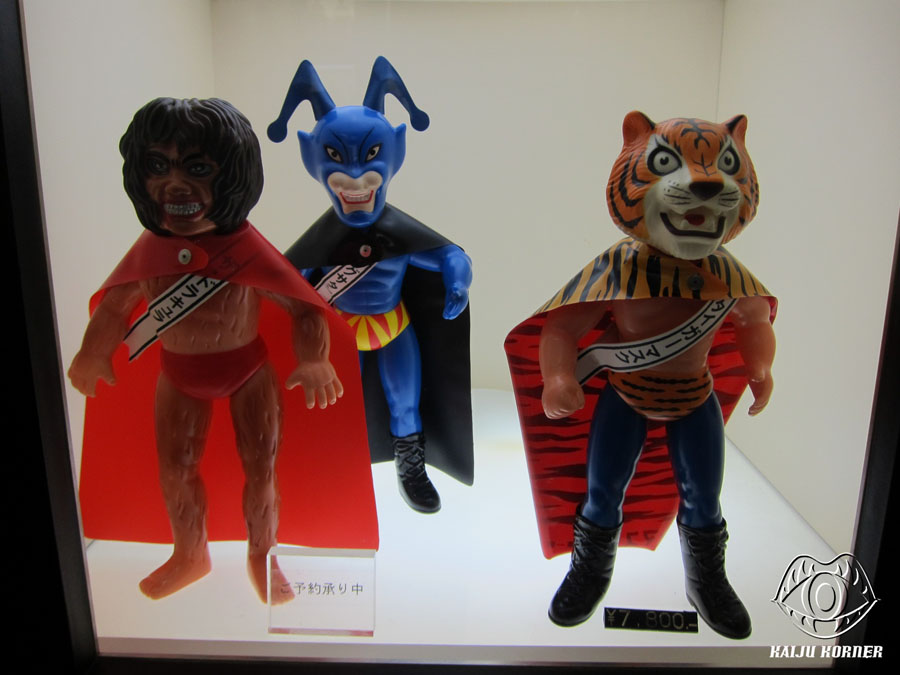
Medicom Tiger Mask figures
Tuesday, December 25, 2012
KK Reviews: Calliope Jackalope by Circus Posterus x Tomenosuke-syoten
Circus Posterus and Tomenosuke-syoten are on a roll! Calliope
Jackalope, designed by Kathie Olivas, is the second figure in the team’s
collaborative line of sofubi figures. The first, Brandt Peters’ Stingy Jack,
was a very long time in the making, requiring the talents of designers, sculptors,
and painters in the US, Europe, and Japan.
The review continues after the jump:
Once the process was worked out and the kinks were smoothed
over, this United Nations of Sofubi Masters kicked it into high gear. With
the wind at their backs, they released Calliope Jackalope within months of Stingy
Jack. The new figure slots in perfectly not only with this line, but also with Kathie’s
previous customs, resin figures, and production releases.
As it’s the holiday
season, I took Calliope out on the town for a series of photo shoots in six
locations. So let’s get to it – it’s Christmas in Tokyo, with Calliope Jackalope.
Let’s start by looking at the packaging.
|
Like other figures
in the line, Calliope, which is 7.5” (190 mm) tall, comes packaged traditional
sofubi style, in a clear plastic bag with a stapled header card.
|
Our first shoot was with a little Christmas tree in front of a convenience store near my house. The tree reminds me of something from Peanuts. It has a
straggly string of lights and plays midi style X-mas tunes on a continuous
loop.
|
Immediately we can see one of Calliope’s unique features:
the articulated legs which spin 360 degrees and allow the figure to sit
perfectly balanced on a ledge. I’ve never seen this done with a sofubi figure,
and it’s a testament to the master skills of both the sculptor - Yohei Kaneko
of Mirock Toys - and Teodoru Badiu, who performed the initial 3D rendering of
the figure. The importance of technical skills can’t be overstated when
producing sofubi toys (or toys with any material), from the design to the wax,
joint, mold, and paint stages.
|
The review continues after the jump:
Saturday, December 22, 2012
Ultraman Ace vs. Henshin Ninja Arashi: A tokusatsu tale
Tokusatsu refers to live action movies or TV shows with costumed heroes and villains. It's a venerable form of entertainment in Japan, going back more than half a century to cinematic trailblazers like Toho's Godzilla (1954) and small screen giants like Tsuburaya's Ultra Q (1966) and then, immediately, Ultraman that same year.
In the 1970s, there was an explosion in new tokusatsu shows. The decade got off to an impressive start with Toei's Kamen Rider (1971), which was created by legendary artist Shotaro Ishinomori. In fact, many of the decade's most famous shows were created by Ishinomori, whose family name at the time was Ishimori - but that's another story.
Following Kamen Rider were other Ishinomori creations like Kikaider, Inazuman, and Gorenger. Then there was Henshin Ninja Arashi, which brings us to this story.
Arashi, a Toei release, follows a similar pattern of other "henshin" tokusatsu of the period. You've got your hero (Hayate), a pair of children, an arch nemesis (in this case, Majinsai), legions of incompetent henchmen (who tend to do somersaults as they go down), and a weekly main villain (sent forth by Majinsai) with a bloodlust for taking down our hero.
When trouble calls, Hayate strikes a pose and becomes Henshin Ninja Arashi, a karate expert with a mean sword and a blazing purple scarf. By the end of the show, Arashi saves the day, sometimes with the help of his trusty steed.
Henshin Ninja Arashi debuted on April 7, 1972. Its timeslot was 7:00-7:30 on Friday evening, a great way for kids to wrap up the school week and get ready for the weekend. So far, so good. Well, maybe not.
Unfortunately for Arashi, Tsuburaya released its newest Ultraman series - Ultraman Ace - that year. You may be thinking that's OK - a little competition can be a good thing, right? It gets worse. Ultraman Ace debuted....yep, you guessed it, on April 7, 1972 - the exact same date as Arashi.
Well, that's OK, right? Kids could watch two shows on one day - awesome! Nope, not so awesome. The Ultra juggernaut slotted in at the EXACT same time as Henshin Ninja Arashi - Friday night from 7:00-7:30, on another channel.
So if you were a kid in the early 1970s, before VHS, DVD, or other recordable media, you had to choose between one show or the other. The person I heard this story from told me that he wanted to watch Arashi, but he ultimately chose Ultraman Ace. And so did the majority of a generation of kids, no doubt. Score a victory for Tsuburaya.
And so things go in the competitive world of children's entertainment. Arashi lasted 47 episodes, which wasn't too bad, but the show became something of a footnote in the legacy of tokusatsu shows. Ultraman Ace went on to broadcast 52 episodes, and the Ultraman franchise continues on in various forms and media to this day.
Toei wasn't down and out by any measure. Its flagship series Kamen Rider carried on strong in various incarnations, through new series and movies, and it never left the popular imagination even when there were no programs airing. It remains an iconic series and there are no doubt epic discussions on forums in many languages about which is better: Ultraman or Kamen Rider. Now that would make a fine Epic Rap Battle of History!
![]() |
| Godzilla, 1954 |
![]() |
| Ultra Q, 1966 |
![]() |
| Kamen Rider, 1971 |
![]() |
| Henshin Ninja Arashi, 1972 |
Arashi, a Toei release, follows a similar pattern of other "henshin" tokusatsu of the period. You've got your hero (Hayate), a pair of children, an arch nemesis (in this case, Majinsai), legions of incompetent henchmen (who tend to do somersaults as they go down), and a weekly main villain (sent forth by Majinsai) with a bloodlust for taking down our hero.
When trouble calls, Hayate strikes a pose and becomes Henshin Ninja Arashi, a karate expert with a mean sword and a blazing purple scarf. By the end of the show, Arashi saves the day, sometimes with the help of his trusty steed.
Henshin Ninja Arashi debuted on April 7, 1972. Its timeslot was 7:00-7:30 on Friday evening, a great way for kids to wrap up the school week and get ready for the weekend. So far, so good. Well, maybe not.
Unfortunately for Arashi, Tsuburaya released its newest Ultraman series - Ultraman Ace - that year. You may be thinking that's OK - a little competition can be a good thing, right? It gets worse. Ultraman Ace debuted....yep, you guessed it, on April 7, 1972 - the exact same date as Arashi.
![]() |
| Ultraman Ace |
So if you were a kid in the early 1970s, before VHS, DVD, or other recordable media, you had to choose between one show or the other. The person I heard this story from told me that he wanted to watch Arashi, but he ultimately chose Ultraman Ace. And so did the majority of a generation of kids, no doubt. Score a victory for Tsuburaya.
And so things go in the competitive world of children's entertainment. Arashi lasted 47 episodes, which wasn't too bad, but the show became something of a footnote in the legacy of tokusatsu shows. Ultraman Ace went on to broadcast 52 episodes, and the Ultraman franchise continues on in various forms and media to this day.
Toei wasn't down and out by any measure. Its flagship series Kamen Rider carried on strong in various incarnations, through new series and movies, and it never left the popular imagination even when there were no programs airing. It remains an iconic series and there are no doubt epic discussions on forums in many languages about which is better: Ultraman or Kamen Rider. Now that would make a fine Epic Rap Battle of History!
Thursday, December 20, 2012
December '12 Pandemonium Show at One Up
One Up Akiba's latest Pandemonium show, with customs by Blobpus, Pico Pico, Todd Robertson, Rampage Toys, and more.
Looks like a lot of the figure have already sold, but some are still available, and as always, if you see something you like, you can send One Up an e-mail to order it. They take Paypal and will ship overseas. Tell them Kaiju Korner sent you. Their e-mail: oneup.webinfo@gmail.com
More after the jump:
Looks like a lot of the figure have already sold, but some are still available, and as always, if you see something you like, you can send One Up an e-mail to order it. They take Paypal and will ship overseas. Tell them Kaiju Korner sent you. Their e-mail: oneup.webinfo@gmail.com
| Dinosaur head shrine! |
Sunday, December 16, 2012
Second Annual Doki Doki Osaka Sofubi Show / ドキドキ大阪ソフビ万博
Today in Osaka, a couple of dozen indie toy makers sold their wares at a rental hall in the Namba district. A solid number of people showed up for the free show, and the makers had quite a nice selection of releases.
However, once the doors opened, it was pure chaos, and an every man for himself melee ensued in the tiny space. Everything was first come first served, and there was a lot of pushing and jostling for position in front of a few booths. As I was told, some people showed up the night before to sleep out in front, but they were turned away, only to show up this morning at 5:00 AM.
I didn't get there nearly that early. Anyway, a few minutes after the doors opened, the dust settled and people gathered their bags (a few people had Santa sized hauls). But the chaos wasn't over, as at least one maker was staggering his releases, leading to more frantic lineups.
Anyway, by about an hour into the show, the majority of toy purchasers were gone, and the makers were hanging out chatting. Then I took off and went to Kobe for a wander.
Here are show pics, arranged alphabetically by maker:
Blobpus:
100+ pics after the jump:
However, once the doors opened, it was pure chaos, and an every man for himself melee ensued in the tiny space. Everything was first come first served, and there was a lot of pushing and jostling for position in front of a few booths. As I was told, some people showed up the night before to sleep out in front, but they were turned away, only to show up this morning at 5:00 AM.
| A shot of the hall after things calmed down. |
Anyway, by about an hour into the show, the majority of toy purchasers were gone, and the makers were hanging out chatting. Then I took off and went to Kobe for a wander.
Here are show pics, arranged alphabetically by maker:
Blobpus:
| one-off |
Friday, December 14, 2012
Indie toys at Paradise Toy Land (Taipei) - International shipping OK
New shots of sofubi and other indie toys available at Paradise Toy Land. You can order online, they take Paypal, and international shipping is OK. The glorious triumvirate!
More after the jump:
Saturday, December 8, 2012
Sunday, December 2, 2012
New Star Case figure: Harlock
This month, Star Case is releasing the first version of the newest figure in its Space Convoy line. This Mock Hamill figure is called Harlock, and it pushes the envelope with what Star Case is doing with the line.
The first thing to note about Harlock is it is SUPER poseable and is made up of 11 parts (well, 13 including the visor and scarf). There is articulation at the neck, waist, arms, elbows, legs, and feet.
More shots of the Jedi master doing tantric Tatooine yoga:
More after the jump:
The first thing to note about Harlock is it is SUPER poseable and is made up of 11 parts (well, 13 including the visor and scarf). There is articulation at the neck, waist, arms, elbows, legs, and feet.
More shots of the Jedi master doing tantric Tatooine yoga:
| This is a paint sample, which was done using Tamiya paints. |
Coming up for Clutter 18
The next issue of Clutter magazine (issue 18), is scheduled for release early in the new year. The issue will have my newest insider look at the world of indie toys. Actually, the purpose of the piece is to bring you, the collectors, into that world, and help you navigate your way through it.
The article will be a guide to Tokyo's biggest toy shows, with a rundown of their details, locations, general time frames, etc. as well as a textual and photographic buffet of what to expect at each show. It's a window into the Japanese toy world, which will provide a sense of what it's like to attend the shows while serving as a useful tool in planning a trip to Tokyo.
So that's an exciting bit of news. Back to the present, Clutter 17 just hit the stands a few weeks back, with my article on Velocitron (Ricky Wilson) - the go-to guy for getting sofubi toys made in Japan, as well as pieces on Paul Kaiju, Skinner, Circus Posterus, Frank Kozik, and more. Click here to get a copy. It's really affordable (just $9.99) and definitely worth it.
Now back to the future...here's some breaking news for Clutter 19, which is a bit down the road. I just had a phone call with one of the coolest cats and hottest indie toy makers out there, and we're cooking up something very unique to bring you for that issue. I'm really stoked about the piece, and I'll have more details for you a bit down the line.
A few of us are working really hard to make great content that will, we hope, stand the test of time. I know people are used to getting a lot of content for free online, and that's cool. But there's still a place for in-depth, content rich, beautiful mags like Clutter. Trust me, each article and issue is a TON of work. Personally I do it for the love of the hobby and don't see anything from it if they sell 1 or 1,000 copies.
But I will tell you that indie toy mags need your support, and at the fraction of the price of a single sofubi figure, in beautiful glossy paper, each issue is a serious bargain. Anyway, that's the end of my pitch. I rarely come on here saying "this thing is really worth buying," but this time, well, I'm saying it, since it is. And we want them to keep putting out the mag and getting the word out about indie toys. And that means we need the support of sofubi heads everywhere. :O)
The article will be a guide to Tokyo's biggest toy shows, with a rundown of their details, locations, general time frames, etc. as well as a textual and photographic buffet of what to expect at each show. It's a window into the Japanese toy world, which will provide a sense of what it's like to attend the shows while serving as a useful tool in planning a trip to Tokyo.
So that's an exciting bit of news. Back to the present, Clutter 17 just hit the stands a few weeks back, with my article on Velocitron (Ricky Wilson) - the go-to guy for getting sofubi toys made in Japan, as well as pieces on Paul Kaiju, Skinner, Circus Posterus, Frank Kozik, and more. Click here to get a copy. It's really affordable (just $9.99) and definitely worth it.
Now back to the future...here's some breaking news for Clutter 19, which is a bit down the road. I just had a phone call with one of the coolest cats and hottest indie toy makers out there, and we're cooking up something very unique to bring you for that issue. I'm really stoked about the piece, and I'll have more details for you a bit down the line.
A few of us are working really hard to make great content that will, we hope, stand the test of time. I know people are used to getting a lot of content for free online, and that's cool. But there's still a place for in-depth, content rich, beautiful mags like Clutter. Trust me, each article and issue is a TON of work. Personally I do it for the love of the hobby and don't see anything from it if they sell 1 or 1,000 copies.
But I will tell you that indie toy mags need your support, and at the fraction of the price of a single sofubi figure, in beautiful glossy paper, each issue is a serious bargain. Anyway, that's the end of my pitch. I rarely come on here saying "this thing is really worth buying," but this time, well, I'm saying it, since it is. And we want them to keep putting out the mag and getting the word out about indie toys. And that means we need the support of sofubi heads everywhere. :O)
Subscribe to:
Posts (Atom)